
One Size Does Not Fit All: Part One
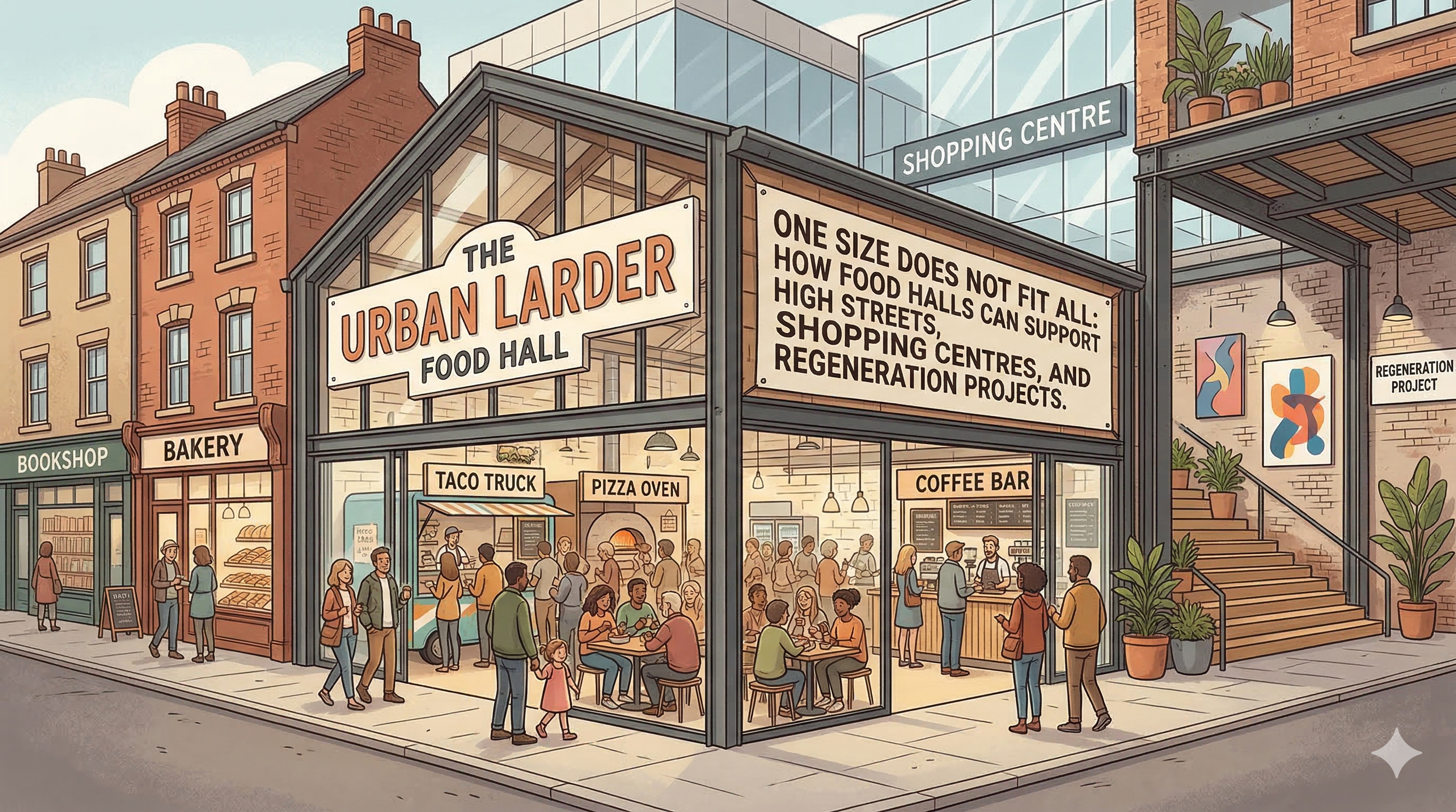
How Food Halls Can Support High Streets, Shopping Centres and Regeneration Projects
Part 1: Understanding the Four Core Models
Introduction: From Amenity to Strategy
Food halls have evolved from lifestyle trend to strategic placemaking tool. No longer just dining destinations, they represent a proven mechanism for activating stranded assets, supporting independent businesses, driving footfall, and restoring vitality to struggling town centres.
The case is strong. Successful food halls demonstrably increase footfall, create all-day and evening economies where retail alone cannot, and prove commercially viable in locations where traditional retail struggles. They create jobs, support local supply chains, and deliver the experiential value that audiences, councils, and developers most need to attract and are actively seeking.
But success is never guaranteed, and there is no universal template. What thrives in a northern city centre may fail in a coastal market town. A destination food hall anchoring a major regeneration scheme requires entirely different infrastructure, investment and operator mix compared to a nimble container market designed to test demand in an emerging location.
The right food hall in the right location can transform a place. The wrong model, or the right model executed poorly, becomes an expensive mistake.
At Next Phase, we work with councils, landlords and developers to identify which food hall model aligns with their specific context: the building, the catchment, the objectives, and the budget. This article sets out the four core models and what makes each one work. In Part 2, we explore how to match these models to specific locations and what determines success.
The Four Core Models
1. Destination Food Halls
Typical size: 14,000 to 40,000 sq ft
Investment level: High (£3m to £10m+)
Development timeline: 18 to 36 months
These are large-scale, experience-led spaces built around food, drink, culture and atmosphere. They aim for regional or city-wide draw, not just local footfall.
Examples: Cambridge Street Collective (Sheffield), Market Halls (London), Shelter Hall (Brighton)
Key characteristics:
High dwell time (90+ minutes average)
Strong bar and evening economy focus (40 to 60% of revenue)
Event programming: live music, cultural activations, private hire
Premium fit-out and brand partnerships
Regional catchment: people travel specifically for the experience
Best suited to:
City centres with strong evening economies
Landmark or heritage buildings capable of supporting destination status
Large-scale regeneration schemes requiring an anchor tenant
Areas seeking to extend activity well beyond retail hours
Critical success factors:
Scale and ceiling height to create atmosphere
Licensed premises and strong bar infrastructure
Access to public transport and car parking
Critical mass of surrounding activity
Professional management and marketing capability
What councils and landlords should know:
Destination food halls require significant upfront investment and operational sophistication. They are not quick fixes. But when executed well, they become the identity piece of a place, driving tourism, media attention and long-term value creation. They perform best where strong fundamentals already exist: transport links, existing footfall, a growing residential base, and where a catalyst is needed to capture evening and weekend trade.
Revenue model:
Primarily percentage rent (15 to 30% of trader turnover), alongside bar and events income. Requires a professional operator or specialist management company.
2. Community Food Halls
Typical size: 5,000 to 15,000 sq ft
Investment level: Medium (£800k to £3m)
Development timeline: 12 to 24 months
Community food halls prioritise independents, local identity and social connection. They are rooted in place rather than designed for regional draw, and they balance commercial viability with civic value.
Examples: Altrincham Market (Greater Manchester), HWB Narberth (Pembrokeshire), Buttermill Market (Redruth)
Key characteristics:
Independent traders with strong local roots
Flexible indoor-outdoor spaces
All-day appeal: breakfast through to early evening
High community engagement and loyalty
Often tied to broader high street or town centre strategies
Accessible price points and inclusive offer
Best suited to:
High streets seeking to differentiate from retail chains
Market towns with strong local identity
Neighbourhood regeneration projects
Locations that need to build or restore civic pride
Critical success factors:
Authentic local operator mix (not franchise-led)
Strong connection to the surrounding high street
Flexible spaces that support different trading patterns
Community partnerships with councils, BIDs and social enterprises
Lower operating costs to support independent viability
What councils and landlords should know:
Community food halls are not simply smaller versions of destination halls. They serve a fundamentally different purpose. They work best where latent community demand exists alongside a desire for local identity. They require patient capital, supportive landlords, and a longer-term view of success. Revenue per square foot will typically be lower than destination formats, but the civic return on investment can be substantial: spending retained locally, startups supported, and gathering spaces that build genuine community resilience.
Revenue model:
Fixed rents or affordable service charges, often with council or grant support during early stages. Requires active management but lower operational overheads than destination formats.
3. Food Halls in Modern Markets
Typical size: 10,000 to 25,000 sq ft (combined market footprint)
Investment level: Medium to high (£1.5m to £5m, depending on scope)
Development timeline: 12 to 30 months
This model uses food halls and enhanced food zones to modernise traditional markets, blending heritage with hospitality. The aim is evolution, not replacement: bringing new audiences into buildings that have lost relevance while supporting long-standing traders.
Examples: Doncaster Wool Market, Newport Market, Chester Market
Key characteristics:
Blend of fresh produce, retail and street food
Modernised food and drink zones within historic market structures
Drives footfall into underused areas of the building
Creates all-day activity in place of morning-only trade
Supports existing traders while attracting new demographics
Often council-owned with social and economic objectives
Best suited to:
Market redevelopments and repositioning projects
Town centre buildings with heritage value but declining relevance
Locations with existing footfall but limited dwell time or spend
Council-led regeneration where preservation is a priority
Critical success factors:
Balancing heritage and modernity: respecting the building's character while upgrading facilities
Clear zoning: traditional retail and fresh produce alongside street food and hospitality
Extended trading hours, particularly evenings and weekends
Active management to curate trader mix and maintain standards
Investment in infrastructure: toilets, lighting, HVAC, wifi
What councils and landlords should know:
Traditional markets rarely fail because of lack of affection. They fail because of poor infrastructure, outdated trading models, and unclear purpose. Adding a well-designed food hall or hospitality zone can transform performance, but only if the investment is serious and the management model is professional. Half measures (a few food stalls without proper ventilation, seating or licensing) will not deliver. This model works when councils commit to making the market a modern civic asset, not simply preserving a nostalgic memory.
Revenue model:
Mix of fixed rents (traditional stalls) and service charges or percentage rents (food hall traders). Typically requires council capital investment with medium to long-term payback.
4. Urban Container and Street Food Markets
Typical size: 5,000 to 20,000 sq ft (flexible, often outdoor or semi-covered)
Investment level: Low to medium (£300k to £1.5m)
Development timeline: 6 to 18 months
This format uses shipping containers, modular units or semi-permanent structures to create fast, flexible and affordable street food destinations. It is the most adaptable model: ideal for testing demand, activating temporary sites, or building food culture from scratch.
Examples: Stack (Seaburn), Spark (York), Bustler Market (Nottingham), Ffos Caerffili (Wales), Feast at the Mills (Wigan), Goods Shed (Barry)
Key characteristics:
Quick to deploy and low capital investment
Highly visual and strongly appealing to younger audiences
Ideal for testing operators and concepts before committing to permanent space
Can be temporary or permanent, depending on planning and site requirements
Strong bar-led evening trade
Works on surface car parks, brownfield sites, or land awaiting development
Best suited to:
Early-stage regeneration sites needing immediate activation
Surface car parks or vacant land awaiting long-term development
Fringe locations that need footfall catalysts
Towns seeking to build or revive a food scene
Seafront or leisure destinations seeking seasonal or year-round activation
Critical success factors:
Strong branding and identity: needs to feel like a destination, not a pop-up
Licensed premises and quality bar offer
Weather resilience: covered seating, heating, lighting
Clear planning and licensing pathways
Active social media and event programming
Low rents to support operator viability
What councils and landlords should know:
Container markets are not cheap stopgaps. They are serious placemaking tools that can transform perceptions and unlock investment. Stack helped revive a struggling Sunderland seafront. Spark gave York a contemporary food destination it previously lacked. Goods Shed in Barry is playing a central role in the town's wider regeneration story, demonstrating how a well-executed container market can become a catalyst for confidence and investment in locations that have been overlooked for years. But they require genuine commitment: quality operators, active management, and investment in infrastructure (power, water, waste, wifi). Done well, they punch far above their weight.
Revenue model:
Affordable fixed rents or licence fees, often with council or landowner subsidy during the initial phase. Lower revenue per unit but high community impact and strong brand value.
What Comes Next
Understanding these four models is the foundation. But the critical question remains: which model fits your location, your building, and your objectives?
In Part 2, we explore how to match these models to specific location types: high streets, shopping centres, heritage buildings, transport hubs, and early-stage sites. We also cover the critical success factors that determine whether a food hall thrives or fails, the common pitfalls to avoid, and how to approach feasibility and planning.
Contact us to find out more about the food hall industry.