
One Size Does Not Fit All: Part Two
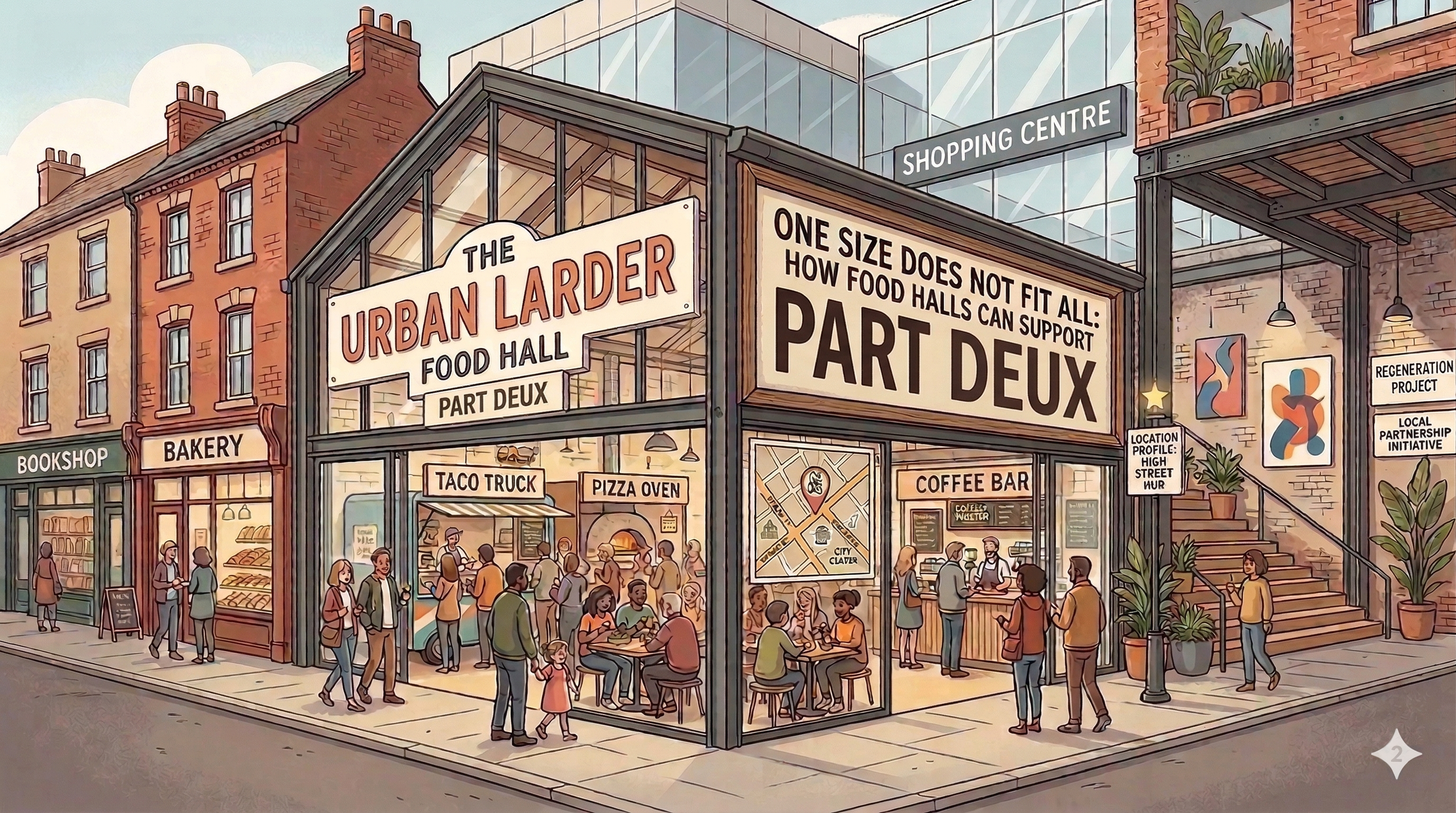
How Food Halls Can Support High Streets, Shopping Centres and Regeneration Projects
Part 2: Matching the Model to Your Location
Introduction
In Part 1, we explored the four core food hall models: Destination Food Halls, Community Food Halls, Food Halls in Modern Markets, and Urban Container/Street Food Markets. Each has distinct characteristics, investment requirements, and intended outcomes.
But understanding the models is only half the challenge. The critical question for councils, landlords and developers is: which model fits our location, our building, and our objectives?
This is where most food hall projects succeed or fail. A destination food hall in the wrong location becomes an expensive white elephant. A container market without proper infrastructure becomes a temporary eyesore. A community food hall without genuine community engagement becomes a commercial failure.
In Part 2, we provide a practical framework for matching food hall models to specific location types. We also explore the critical success factors that apply across all formats, the common pitfalls to avoid, and how to approach feasibility with clear eyes.
Matching the Model to the Location
Choosing the right food hall format is not a creative exercise; it's a strategic decision based on context, catchment, competition and commercial reality. Below is a breakdown of how each model aligns with the most common location types councils and developers are working with.
High Streets
Challenge:
Declining footfall, vacant units, competition from retail parks and online shopping, and loss of the evening economy.
Best supported by:
Community Food Halls
Market-Based Food Halls (where a traditional market exists)
Container and Street Food Markets (on gap sites or car parks)
Why these models work:
They support independents and reflect local identity
They feel authentic and relatable, not corporate
They activate mornings, afternoons and evenings
They accommodate mixed demographics and lower price points
They can integrate with existing high street retailers and hospitality
Success factors:
Local operators with community connection
All-day usage to maximise footfall at different times
Social and cultural value, not just commercial
Accessible pricing (£8–£16 average spend)
Strong indoor-outdoor flexibility for British weather
Active partnership with BIDs, town teams and local councils
What to avoid: Trying to replicate a city-centre destination model in a market town. High streets need familiarity and accessibility, not aspiration and Instagram moments.
Shopping Centres
Challenge:
Declining retail demand, large vacant anchor units, lack of dwell time, and limited evening or weekend footfall outside of retail hours.
Best supported by:
Destination Food Halls (in the right location with strong catchment)
Hybrid or commercial food zones within traditional markets (if applicable)
Select Community Food Hall formats (in neighbourhood or suburban centres)
Why these models work:
They increase dwell time significantly (from 45 minutes to 90+ minutes)
They create reasons to visit beyond retail: socialising, dining, events
They make large vacant floorplates commercially viable
They support bar-led revenue, which extends trading into evenings
They appeal to younger demographics that shopping centres struggle to attract
Success factors:
Clear, accessible connection to main footfall routes
Reliable lunch, evening and weekend trade
Strong bar offer with extended licensing
Ability to handle high volumes at peak times (lunch, Friday/Saturday evenings)
Professional management and marketing
Integration with centre-wide programming and events
What to avoid: Underestimating the infrastructure required. Destination food halls need proper ventilation, grease management, bin storage, acoustic treatment, and servicing. They are not plug-and-play tenants. Councils and landlords must invest properly or the concept will fail.
Heritage Buildings and Major Regeneration Schemes
Challenge:
Bringing new life to landmark buildings without compromising character, creating anchors for wider regeneration, attracting investment and confidence.
Best supported by:
Destination Food Halls
Modern Market Food Halls (where historic markets exist)
Select Community Food Hall models (in smaller heritage buildings)
Why these models work:
They can anchor entire regeneration strategies
They bring people into historic buildings in a modern, relevant way
They create reasons to visit, stay longer, and return
They accommodate cultural programming, events and private hire
They respect architecture while inserting contemporary use
Success factors:
Strong placemaking and storytelling around heritage
Respect for architecture: sensitive fit-out, retention of character
Diverse operator mix that reflects both quality and accessibility
Events and cultural activation beyond just food
Partnership with local cultural organisations, tourism bodies
Long-term commitment and patient capital
What councils and landlords should know: Heritage food halls often become the identity piece of regeneration, they are what people remember, photograph and share. This makes them incredibly valuable but also high-stakes. Get the fit-out, operator mix or management wrong, and the building becomes a liability instead of an asset. These projects require serious investment (often £2m-£5m+), experienced development partners, and professional operators who understand both hospitality and heritage.
Transport Hubs and Office Districts
Challenge:
Serving high-volume, time-sensitive audiences. Need for speed, variety, and convenience.
Best supported by:
Fast-casual and compact food hall formats
Container and Street Food Markets in outdoor or fringe locations
Compact versions of Destination Food Halls (where footfall and density support them)
Why these models work:
High throughput and turnover
Breakfast, lunch and early evening trade
Multiple cuisines and dietary options in one location
Tech-enabled ordering and payment
Smaller, efficient footprints that fit into awkward spaces
Success factors:
Fast service (under 10 minutes from order to food)
Clear circulation and queuing systems
Strong grab-and-go offer alongside seated dining
Clean, simple operating model with minimal barriers to access
Proximity to offices, stations, universities
What to avoid: Complex, leisurely dining concepts. These locations are about speed and convenience, not lingering.
Early Stage, Underserved or Transitional Locations
Challenge:
Limited food culture, low confidence, sites awaiting long-term development, and need for quick wins to build momentum.
Best supported by:
Urban Container and Street Food Markets
Community Food Halls in smaller footprints (under 10,000 sq ft)
Pilot versions of Market-Based Food Halls
Why these models work:
Quick to deploy (6–12 months)
Low cost compared to full redevelopment
Attract young independents willing to take risks
Build food culture and consumer confidence where none exists
Test demand before committing major capital
Generate immediate footfall and activity
Success factors:
Fast activation with visible progress
Simple licensing and planning processes
Strong branding and identity from day one
Flexibility to scale up, adapt or wind down
Active social media and event programming
Partnership with local business support organisations
What councils should know: These formats are not “cheap and cheerful” stopgaps, they are serious placemaking tools that can transform perceptions and unlock investment. Stack Seaburn helped revive a struggling seafront. Feast at the Mills created a new destination in Wigan. Goods Shed Barry is playing a central role in the town’s wider regeneration story. Spark gave York a contemporary food destination it previously lacked. But they require commitment: good operators, active management, and willingness to invest in infrastructure (power, water, waste, wifi). Done well, they punch far above their weight.
Critical Success Factors Across All Models
Regardless of format, food halls succeed or fail based on a consistent set of fundamentals. Councils, landlords and developers should assess every opportunity against these criteria:
1. Catchment and Footfall
Is there sufficient residential, working or visiting population within a 10–20 minute walk?
What is the existing footfall, and when does it occur?
Can the food hall extend trading into currently weak periods (evenings, weekends)?
2. Operator Quality and Mix
Are you attracting genuinely good operators, or just filling units?
Is there diversity of cuisine, price point and trading style?
Are operators financially viable and professionally run?
3. Infrastructure and Building Suitability
Does the building support food use (ventilation, grease management, bin storage)?
Is there adequate power, water and drainage?
Are toilets, accessibility and fire safety up to standard?
4. Licensing and Planning
Can you secure appropriate licensing for alcohol and late-night operation?
Are planning constraints manageable, or will they undermine viability?
5. Management and Operations
Who will manage the food hall day-to-day?
Is there a clear operational model and budget?
Are service charges or rents set at levels that support both landlord return and operator viability?
6. Marketing and Activation
How will people know the food hall exists?
Is there a budget for marketing, social media and events?
Is there a clear brand and identity?
7. Long-Term Sustainability
Is this a short-term activation or a permanent destination?
What is the exit strategy if it underperforms?
How does it fit within the wider regeneration or placemaking strategy?
Common Pitfalls (And How to Avoid Them)
Pitfall 1: Copying What Worked Elsewhere
Every successful food hall is context-specific. Altrincham Market worked because of strong community engagement and a passionate local champion. Time Out Market works because it targets tourists in global cities. Trying to replicate either model without understanding why it succeeded will likely fail.
Solution: Start with your context, the building, catchment, competition, and objectives and design the model around that, not around what you've seen work elsewhere.
Pitfall 2: Underinvesting in Infrastructure
The most common reason food halls fail is poor infrastructure: inadequate ventilation, insufficient power, inadequate toilets, and poor acoustics. Operators cannot succeed if the building does not support them.
Solution: Commission proper feasibility studies and M&E assessments before committing. Budget realistically for infrastructure upgrades. Do not cut corners.
Pitfall 3: Over-Optimistic Revenue Assumptions
Food halls are not magic. They require footfall, good operators, effective marketing, and time to establish. Assuming immediate profitability or unrealistic service charges will either deter good operators or lead to financial failure.
Solution: Model conservatively. Assume 12–18 months to reach steady-state trading. Build in contingency. Understand that community and social returns may be as important as financial returns.
Pitfall 4: Weak Operator Recruitment
Filling units with whoever will sign a lease is a recipe for mediocrity. Food halls live or die on the quality and variety of their offerings.
Solution: Recruit actively. Offer support to independents. Curate the mix. Be willing to say no to operators who do not meet standards.
Pitfall 5: Lack of Active Management
Food halls are not passive investments. They require daily management: trader liaison, marketing, events programming, cleaning, maintenance, and conflict resolution.
Solution: Budget for professional management from day one, either in-house or via an experienced operator. Do not assume traders will self-manage.
Why Food Halls Matter Now
The economic and social case for food halls has never been stronger.
For councils:
They activate stranded assets that would otherwise sit vacant
They support local independents and job creation
They increase footfall and dwell time, benefiting surrounding businesses
They attract younger demographics and build evening economies
They deliver social value: community spaces, cultural programming, civic pride
For landlords and developers:
They generate rental income from otherwise unviable space
They increase asset value and marketability
They provide experiential content that complements retail or residential
They create differentiation in competitive markets
For communities:
They provide affordable, accessible social spaces
They support local entrepreneurs and food culture
They create gathering places that build social connection
They offer alternatives to chain-dominated high streets
But none of this happens by accident. It requires the right model, in the right location, with the right investment and management.
The Next Phase Approach
The difference between a food hall that transforms a place and one that becomes a liability is rarely about the concept. It’s about how well the model fits the location, how seriously the infrastructure is taken, how carefully the operators are recruited, and how professionally the venue is managed once the doors are open.
At Next Phase, we have worked on destination food halls, community markets, heritage transformations and container activations. We understand what works, what doesn’t, and why. We do not offer off-the-shelf solutions because none exist. Every location is different. Every building has its own constraints and opportunities. Every council, landlord and developer has different objectives, budgets and timescales.
Our role is to help you identify the model that fits your context, navigate the feasibility and planning process with clear eyes, recruit the operators that will make it work, and manage the venue in a way that delivers long-term value for the place and the people in it.
If you are a council, landlord or developer exploring what a food hall could do for your location, we would welcome the conversation.
Contact Us
Next Phase
Email: hello@nextpha.se
Web: www.nextpha.se
Let's start the conversation about what food halls can do for your place.
Read Part 1: Understanding the Four Core Models